
-
Battery prices to rise from January 2027. China ends export VAT refund
The price of lithium is more than 60 per cent higher than it was last autumn; battery cells have also become more expensive, and from 1 January 2027, China will completely abolish the VAT export refund on batteries. For photovoltaic panels, a similar change this year was accompanied by a sharp rise in prices. We therefore expect the start of next year to bring further price increases for batteries.
Batteries have seen several years of almost continuous price falls. That has changed this year.
Lithium prices and cell prices have both risen. And from January, there will be a further change affecting batteries exported from China.
From 1 January 2027, China is abolishing the remaining 6% VAT refund on exports of battery products. This involves the refund of part of the Chinese VAT to exporters. The decision by the Chinese Ministry of Finance and the tax authorities is already in force. The rebate was reduced from 9 per cent to 6 per cent in April this year and will be zero from the New Year.
The trend is therefore straightforward:
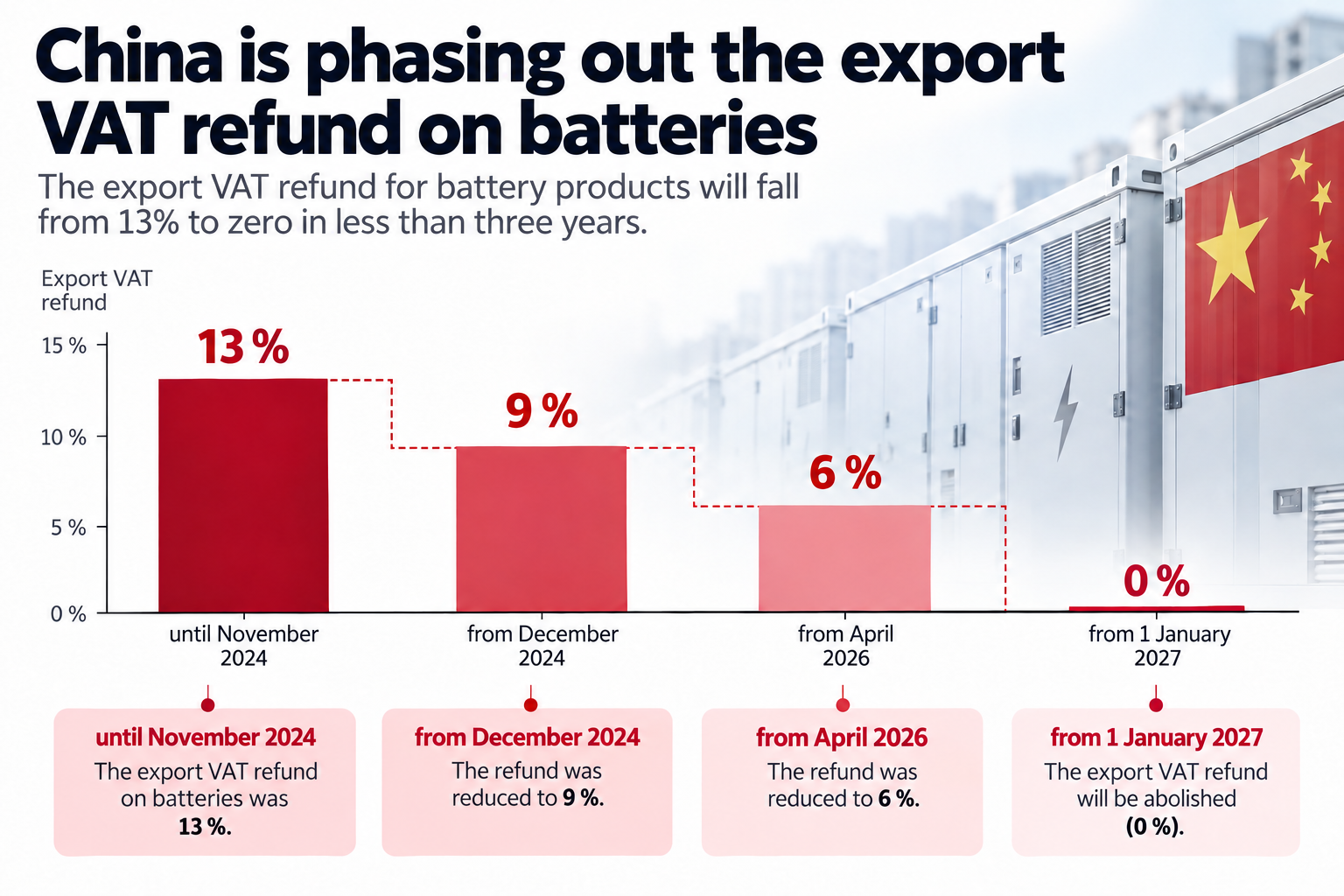
In just over two years, China will thus gradually abolish the entire preferential rate, which previously stood at 13 per cent.
We saw what might follow with solar panels this year
Photovoltaic panels underwent the same change a few months earlier. Their export rebate fell from 9 per cent to zero from 1 April 2026.
Back in January, we warned that panel prices would rise and that the end of Chinese export subsidies would coincide with higher prices for raw materials and other inputs.
Prices did indeed shoot up even before the April deadline.
The OPIS benchmark for Chinese TOPCon modules rose by more than 30 per cent within a few weeks from mid-December. In just one week in January, the price jumped by a further 12.75 per cent.
The cancelled rebate alone amounted to 9 per cent.
The panel prices thus clearly demonstrated that a change in export conditions does not necessarily mean a price increase of exactly the same magnitude. At the same time, manufacturers were grappling with more expensive inputs, particularly silver, rising production costs and efforts to bring prices back to a more sustainable level. By the end of January, according to OPIS, Chinese TOPCon modules were nearly 35 per cent more expensive than at the start of the year.
Furthermore, in the run-up to 1 April, there was a significant surge in demand for deliveries under the old terms.
The same reason for stockpiling is now emerging for batteries. This is because the decisive factor is the export date stated on the Chinese customs declaration, not the order date. Goods that do not leave China until January will no longer qualify for the current 6 per cent rebate.
Lithium is more than 60 per cent more expensive than it was last October
The second part of the equation concerns the batteries themselves and their components.
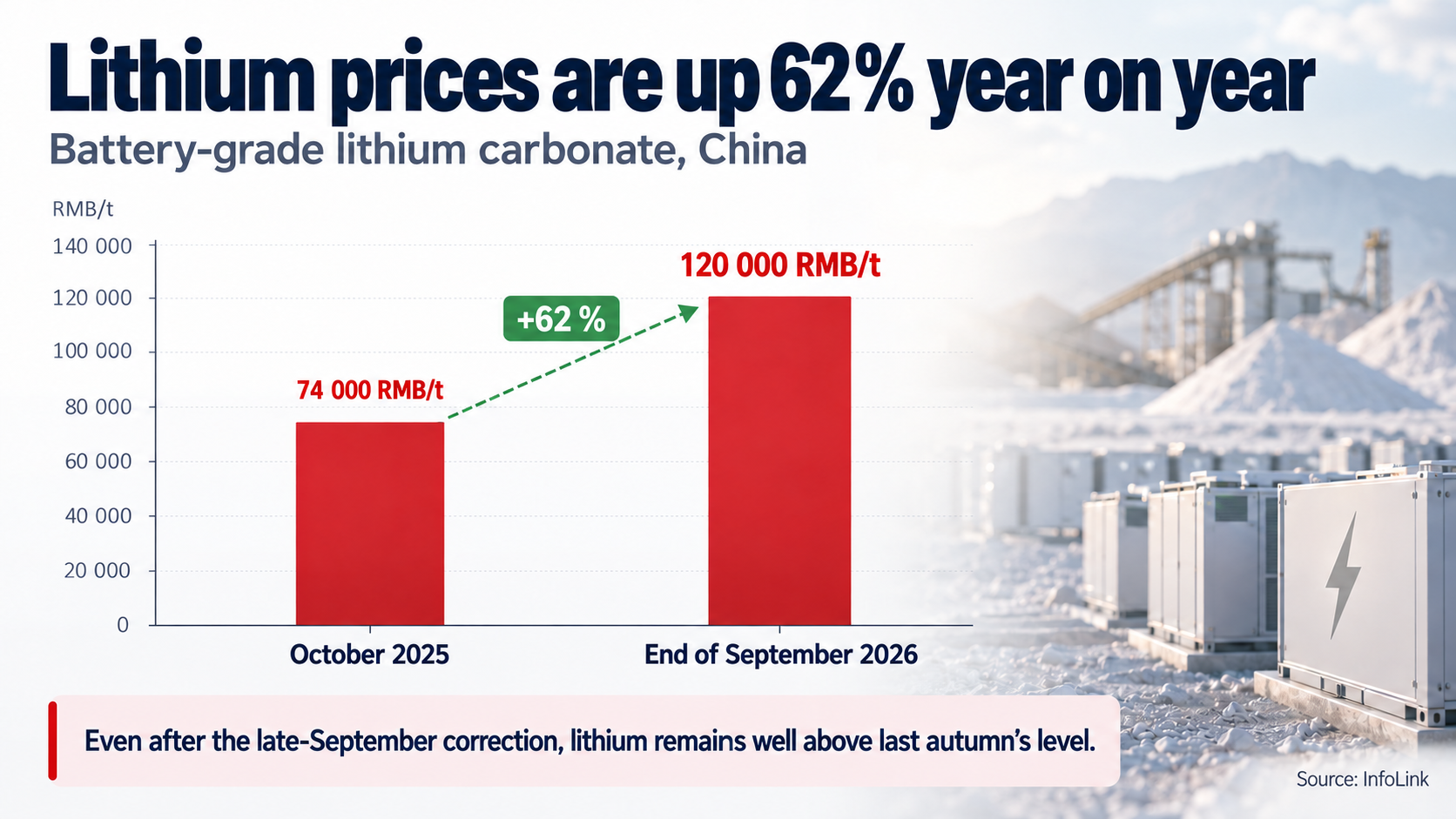
In October 2025, a tonne of battery-grade lithium carbonate cost approximately 74,000 RMB in China .
During the course of this year, the price rose sharply, then fell again. At the end of September, following a significant correction, it stood at approximately 120,000 RMB per tonne.
Even after this fall, lithium is still around 62 per cent more expensive than it was in October 2025.
A similar trend can be seen in the cells used in large-scale battery storage systems.
The price of a 314Ah LFP cell rose from approximately 0.300 RMB/Wh last October to 0.363 RMB/Wh at the end of September this year.
Complete BESS systems are not yet rising in price at the same rate. Part of the higher costs remains with the cell manufacturers and system integrators. Chinese prices for finished systems remained relatively stable at the end of September, even though the cells themselves were significantly more expensive year-on-year.
From January, these higher input costs will be compounded by the end of the 6 per cent export rebate.
As regards panels, we have pointed out that prices will rise
“At the start of the year, we warned that panels would become more expensive. And we were right. Chinese prices for TOPCon modules rose by more than 30 per cent within a few weeks. The cancellation of the rebate alone accounted for nine per cent of that increase. With batteries, we are now seeing several similar factors at once. Lithium is more than 60 per cent more expensive than it was last October, the price of cells has risen by roughly a fifth, and the final 6 per cent export rebate comes to an end in January. I would therefore certainly not expect any price increase to be limited to six per cent.
As early as last week, some of our suppliers agreed to a partial price increase to prevent a sudden surge, as was the case with solar panels. Even so, we expect a stockpiling of technology for major projects due to be implemented in H1 2027, which could increase the price of batteries by more than 10 per cent in the short term,” explains Radek Orság, CEO of SOLSOL.
Anyone planning a BESS for next year should address the issue of price now
As recently as last year, it made sense for many projects to wait before purchasing batteries. Prices had been falling over the long term, and each successive quarter often brought cheaper technology.
At the end of 2026, the situation is different.
Lithium prices are up by more than 60 per cent year-on-year. Battery cells are roughly a fifth more expensive. And in just under three months, the final portion of the Chinese export rebate will disappear.
Furthermore, experience with solar panels has shown that the market does not adjust to such a change only on the day it comes into effect. Prices and availability begin to change several months in advance.
For BESS projects planned for the first half of 2027, we therefore recommend finalising supply and pricing arrangements before the end of this year.
This makes the most sense for projects where the required capacity and output are already known and where it is possible to secure the technology, production date or price today.
After several years of falling battery prices, the market trend may well change at the turn of the year.
SOLSOL has been your reliable partner in solar energy since 2012.
All orders are subject to the General Terms and Conditions. Copyright © 1996-2023, SOLSOL s.r.o.
User consent settingsMo-Fr 8:00-16:30